Its all very well and possible and in fact great to improve the soil around your house with compost , but if you want to turn vast tracts of poor soil into productive soil with a higher level of carbon and therefore a great infiltration of water and a holding of that water like a sponge.......you just about need grazing animals. But not grazing any old how. They need to be managed . Holistically managed. Enter Allan Savory, a great man and a keen observer of nature.
In this speech, Allan takes us on a historical journey and points out that we would be struggling with climate change even if we had never discovered fossil fuels. By managing our live stock so that they mimic the way grazing animals behave in the wild, we have a fantastically powerful tool to suck carbon out of the air and put it back into the soil where it use to be before humans came along and , frankly, stuffed everything up.
This is an inspiring, well illustrated talk which cuts across accepted beliefs. Allan reminds us we once believed the Earth was flat and it took 200 years to accept a new world view. Particularly important if you believe you are doing something good for the planet by reducing or eliminating meat consumption ...well, check this out :
Allan Savory - Keeping Cattle: cause or cure for climate crisis? on Vimeo
Wednesday, February 29, 2012

Bobby Burns Worms
Hi All, I met this guy Robert Burns at Geoff Lawton’s place when I did my earthworks for water harvesting course. He was a woofa . I did notice his eyes were looking not quite at me when we talked. I now realise he is partially blind. I think his Ted X speech is one of the best I have seen and I urge you to give Bob Burns 15 mins of your time. Want to ask him to be a tour guide on our farm. Enjoy.
http://www.youtube.com/watch?v=SfACqJ_XLMA
Monday, January 16, 2012
Dr Tom Chalko ....Mt Best Sustainablility
I've just spent a fascinating hour exploring the website of Dr Tom Chalko who holds a PhD in holographic light since 1979. Yes, he is a Brain, and he has put his considerable intelligence towards achieving sustainability. Highlights for me are his chest freezer to fridge conversion and bubble wrap window insulation.... both are fantastic innovations which look surprisingly great and work well. The fridge uses a tenth of the energy of a conventional fridge. Having just had a $2,000 4 year old fridge conk out on us, I will be ordering a chest freezer conversion kit from the Amazing Dr Chalko online shortly and never entering Harvey Norman for a 5 year wonder destined- for- the- tip again.. Tom has created a wonderful abode at Mt Best in the general vicinity of Wilson"s Promontory in Victoria. He has been regenerating rain forest, building a fully renewable energy efficient waste recycling home and has constructed a gorgeous dome glasshouse. He writes books, conducts retreats (where you can learn to read auras, walk in the rainforest and and swim in a natural pool with cascading waterfall) and does all this at very reasonable cost. I love him. Here's the link to this marvellous man's website http://www.mtbest.net/index.html
Sunday, January 8, 2012
Sunday, January 1, 2012
Bamboo is Beautiful !
Happy New Year ! If it isn’t The year of the Bamboo, it should be! See below.

Apricots, lemons, radish, beans, strawberries, rhubarb, amaranth, silverbeet, basil, sweetcorn, turnips, carrots, parsnip, potatoes, garlic, onions, eggs, and many other fantastic nutritious food. Phone us on 97561408 to arrange a time to shop here in Nannup. And while you are here, admire the bamboo.
BAMBOO is a true WONDER PLANT !
“BAMBOO COULD BE DEEMED THE MOST INFLUENTIAL, IMPORTANT PLANT TO HUMAN KIND AND THE ECOSYSTEM “
Apologies to who said that, ever so sorry but I am not sure who it was, but I agree.
It could have been Victor Cusack. He has written a greatly helpful book called “Bamboo Rediscovered”, which is one of my faves. He goes into the cultivation of various breeds, propagation , managing a plantation for timber or edible shoot production, special joining techniques for building, furniture fences and musical instruments.
But first some fact about bamboo that will astound you:
In addition to not requiring pesticides or fertiliser to grow, it reaches its mature harvested height in 3 to 5 years (versus 10-20 years for most softwoods).
BAMBOO generates up to 35% more oxygen than hardwood trees, and absorbs four times as much carbon as hardwood.
BAMBOO can detoxify wastewater (due to its high nitrogen consumption) and improve soil quality.
It has been grown and husbanded for thousands of years and has been on Earth for over 200 million years.

Bamboo, the biological airconditioner! When its 39 celcius, as it was the other day on the farm, our chooks , chicks and ducks don’t stray far from the shade of this fledgling bamboo .
Bamboo has the widest range of uses and the widest spread of habitats. It is a woody perennial evergreen plant that is actually part of the true grass family. Although they can grow to towering heights, bamboo is not actually considered a tree. Bamboo belongs to the family Poaceae, subfamily Bambusoideae, tribe Bambuseae.
Bamboo along with being one of the tallest grasses in the world, is also the fastest growing plant in the world, capable of growing 1M per day! Bamboo is the fastest growing woody plant on this planet. It grows one third faster than the fastest growing tree. Watching the new bamboo shoots emerge in the spring and early summer is a phenomenon unlike any other a gardener is likely to experience. The new shoots emerge from the ground the diameter that the full culm will be, and then grow to their full height in about 60 days. These culms never grow any larger. When conditions are favourable, the bamboo will put up larger shoots, to grow into new and larger culms each spring, until the bamboo reaches its maximum size for the species in those conditions. Bamboos are giant, woody grasses which put out several full length, full diameter, naturally pre-finished, ready-to-use culms ("stems") each year. A single bamboo clump can produce up to 15 kilometres of usable pole (up to 30 cm in diameter) in its lifetime.
Bamboo can be found all over the world in varied climates, from the cold mountainous regions to the hot tropical areas. It can quickly provide shade. It creates its own mulch which can be borrowed for poultry nesting boxes ect.
Bamboo utilizes carbon dioxide at a rate astronomically higher than other trees, and does it year around because it is an evergreen.
Bamboo has the fastest reforestation potential of any plant, making a new canopy in burnt landscapes in a matter of months. Bamboo also provides a canopy for the greening of degraded lands, lowering light intensity and protecting soil against ultraviolet rays.
Thomas Edison's first successful incandescent lamp (light bulb) used a filament made of carbonized bamboo. It was patented in 1880. This light bulb still burns today in the Smithsonian Museum in Washington DC . Thomas Edison also used bamboo as rebar for the reinforcement of his swimming pool. To this day, the pool has never leaked. Alexander Graham Bell used bamboo for the first phonograph needle. Bamboo survived the atomic bomb at Hiroshima and provided the first re-greening after the blast in 1945.
With a tensile strength superior to mild steel (withstands up to 52,000 pounds of pressure psi) and a weight-to-strength ratio surpassing that of graphite, bamboo is the strongest growing woody plant on earth. There is a suspension bridge in China 250 yards long, 9 foot wide and rests entirely on bamboo cables fastened over the water. It doesn't have a single nail or piece of iron in it.
Used in ladders, scaffolding and construction, bamboo is twice as stable as oak, walnut and teak.
Bamboo can be made into fabric : linen, towels, socks,etc .BAMBOO fabric has natural anti-bacterial and anti-fungal properties too. BAMBOO has natural “wicking” properties meaning that it absorbs and evaporates moisture very quickly. BAMBOO is anti-bacterial even after 50 washes,– this natural anti-bacterial function along with the excellent permeability and evaporation of moisture makes BAMBOO apparel more odour-free, and the fabric itself is also incredibly smooth ….great for people with allergies and sensitive skin.
Bamboo has thousands of uses including airplane "skins", aphrodisiacs (!?) , blinds, brushes, crafts, desalination filters, diesel fuel, fly-fishing poles, flooring, food, furniture, medicine, musical instruments, ornaments, paper, rope, scaffolding, chopping boards, back scratchers, umbrellas, walking sticks, wind chimes and many, many, more. Bamboo is harvested and replenished with no impact to the environment. It can be selectively harvested annually and is capable of complete regeneration without need to replant.
It provides income, food, and housing to over 2.2 billion people worldwide.
The new shoots emerge from the ground the diameter that the full culm will be, and then grow to their full height in about 60 days. These culms never grow any larger. When conditions are favourable, the bamboo will put up larger shoots, to grow into new and larger culms each spring, until the bamboo reaches its maximum size for the species in those conditions. Bamboos are giant, woody grasses which put out several full length, full diameter, naturally pre-finished, ready-to-use culms ("stems") each year.
Bamboo plants can be classified as “clumpers” which expand in size but virtually stay put and “runners” which spread underground roots rapidly . Shoots can pop up meters from the main plant. It is always recommended that you buy or propagate only clumpers, not runners. Runners are apparently capable of taking over acres of land and generally being a nightmare to eradicate or control. We are not sure that this is the case in WA, and have friends who have grown all types of bamboo for 30 years in Balingup say runners are not as rampant as they are in the eastern states, but we err on the side of caution born of other battles with invasive plants . Consider yourself warned!
At Merri Bee Organic farm we are into bamboo! Some bamboos specialize in having edible shoots, others in producing useful timber for building or furniture. We have found that not only the shoots but the bamboo foliage is relished by many of our animals: cows, sheep, rabbits, even chooks! Unfortunately rats are also partial to its new shoots.
The plant makes a great lot of leaf litter so is a source of mulch.

I love that bamboo seems to condense moisture from the night air and will often be dripping with condensation in the morning where other plants are dry. See! Seew Ss See
As a cheap and ever improving fence, it is super ! Tall, inpenetrable hedges can be formed in a few years from it with the simple aide of a line of trickle irrigation. Try to make this on a contour line for extra benefits like erosion control .Shoots of suitable bamboo species ( clumpers only!, ) are planted 30 cms apart along the trickle line which is placed where you want a fence. This is best achieved by digging out an entire clump of bamboo and dividing it to create many plants. With regular drip irrigation, each plant will produce a clump in a few years , forming a dense fence. Obviously you would not expect a fledgling fence to stand up to a huge herd of cows, but with a mature fence visited infrequently by rotationally grazed stock, a bamboo fence would be very practical and another source of fodder. When you consider your fence is big and wide enough, simply cut right back on the irrigation.
How to propagate this marvellous gift of nature
Its not difficult so have a go! Best time is Spring. Always keep everything wet and shaded when propagating bamboo. Early morning or late arvo would be best operating times.
Branch cuttings
Branch cuttings are good because you can take many branches off a culm and they just regrow . Culm cuttings have a higher and quicker success rate but you need to take a whole mature culm from the plant . Take a large central dominant branch from a mature node . Saw it off, cut it off, carefully remove it somehow trying to reduce damage to the parent culm or swollen part of base of branch.
After removal, cut the primary branch off just above the second or third node, and cut off any secondary branches immediately after the first bud. Stick these cuttings in a pot of course sand and water in. Thereafter, keep in a shaded, humid environment, misting with water a few times a day.
The best method we have found... Culm cuttings
We took 2 mature ( meaning at least 12 months old) culms about 12 feet long from which we obtained 9 new plants in about 6 weeks. Stewart learnt this method in QLD from his mate Stan White. You cut the culm such that there is about 6 inches of culm left below a node. This you bury in sand. Leave a few branches on the node which will stick out of the sand. Remove all the big leaves from it.... leave one small one only. The cuttings should be about a foot long, because you are going to have 6 inches( 150 mms for my younger friends) of culm above and about 4 " or 100 mm below each node. ASAP, place the cuttings, as you make them with a pruning saw and secateurs, in a bucket of water ...THE RIGHT WAY UP! I use recycled deep polystyrene boxes half filled with course sand . The pots or boxes of cutting must be kept in a shady and humid environment for the next 6 weeks. To create this we threw some UV light stabilized plastic, followed by some shade cloth over a frame and set up a trickle pipe with a misting mini sprinkler and a timer tap. The timer tap was the best $40.oo I ever spent, as no matter how busy or forgetful I am, the cuttings receive 3 X 1 minute bursts of fine "rain" every 24 hours. Wonderful! It is always important not to fully rely on such gadgets however, as its easy for a pipe to blow off its joiner and this happened when I was away and Stew was in charge.Grrr. Lost a box of coprosma cuttings due to that oversight ... cest la vie.
Place your cuttings into the sand , with the node just under ground level. Roots will form from the node.
Now for the tricky bit that ensures the success of this method. Fill the 6 inches of culm sticking up with water!
I wish you luck propagating the biological air con, it really is a gorgeous plant.
The best method we have found... Culm cuttings
We took 2 mature ( meaning at least 12 months old) culms about 12 feet long from which we obtained 9 new plants in about 6 weeks. Stewart learnt this method in QLD from his mate Stan White. You cut the culm such that there is about 6 inches of culm left below a node. This you bury in sand. Leave a few branches on the node which will stick out of the sand. Remove all the big leaves from it.... leave one small one only. The cuttings should be about a foot long, because you are going to have 6 inches( 150 mms for my younger friends) of culm above and about 4 " or 100 mm below each node. ASAP, place the cuttings, as you make them with a pruning saw and secateurs, in a bucket of water ...THE RIGHT WAY UP! I use recycled deep polystyrene boxes half filled with course sand . The pots or boxes of cutting must be kept in a shady and humid environment for the next 6 weeks. To create this we threw some UV light stabilized plastic, followed by some shade cloth over a frame and set up a trickle pipe with a misting mini sprinkler and a timer tap. The timer tap was the best $40.oo I ever spent, as no matter how busy or forgetful I am, the cuttings receive 3 X 1 minute bursts of fine "rain" every 24 hours. Wonderful! It is always important not to fully rely on such gadgets however, as its easy for a pipe to blow off its joiner and this happened when I was away and Stew was in charge.Grrr. Lost a box of coprosma cuttings due to that oversight ... cest la vie.
Place your cuttings into the sand , with the node just under ground level. Roots will form from the node.
Now for the tricky bit that ensures the success of this method. Fill the 6 inches of culm sticking up with water!
I wish you luck propagating the biological air con, it really is a gorgeous plant.
Cheers ! The merry Bee
Tuesday, December 27, 2011
 Establishing a food forest can intially look yuk! But wait!
  Looking better a few hours later. Two new mountain paw paw have been planted . The piles of sticks are to keep chooks from scratching up the young avocado tree roots. Once again, a temporary eyesore.
 Ahh! That's better....and wow we have disposed of some dead bodies, manure, recycled lots of waste cardboard and newspapers that would have otherwise been burnt at the Nannup tip ( disgusting, but that's changing soon) , and caught up with the news from 6 weeks ago while mulching. But best of all we have ousted kike, which isnt much feed value for grazing animals and worse, it exudes a pheromone will positively stunt your young fruit trees.
 Here's a pic of the Humungus garden in march 2005. Me and my sow Magnolia chose to meticulously dig out a large area of solid kikuyu grass to establish this garden. It took 30 minutes to weed out each square foot. Anyone would be tempted to reach for the Round Up. Not me, perverse creature that I am. Even though the story was at the time that Round Up left no residues I didn't believe it and I weeded like a woman possessed for weeks to clear the kike and get veges growing. Monsanto was found guilty of false advertising regarding its best selling herbicide in French courts in 2009. It is being realised now just how damaging to health and soil glyphosate is, but more particularly Round Up, which contains adjuvants that enable the toxins to enter cells more easily.
But there is much easier but slower way to get rid of kike and that is to sheet mulch the entire area, excluding the light from this terribly invasive grass, without which I feel I would be a lady of leisure. Six months of light starvation will kill kikuyu, but you have to patrol for little bits poking through the mulch and pluck them out regularly for the first 6 months, as they will keep the root system alive and very soon your mulch will be again smothered in kike. It has a way of sneaking in from the edges too. Kike can grow underground for about 6 feet or 2 m....give it some water and it will do just that in a few days. But never fear, Bill Mollison's sheet mulching is here. Thanks again Bill! Here's my in depth instructions on how to turn a kike infested area into a low maintenance food forest:
I love mulching. There is nothing more satisfying and labour/cost effective way to create a garden! A mulch garden will
1) radically improve the soil,
2) eradicate weeds
3) mimimize irrigation ( see point 1 above. A soil rich in carbon , or humus, absorbs and holds 6 times more water than a low carbon soil) .
4) look lovely and feed you and many creatures both wild and tame.
Spring and early summer is the ideal time to start an instant garden in a kikuyu patch. First amass some newspapers, plain brown cardboard ( I limit the use of gaily coloured glossy mags and cardboard do contain toxic inks) and piles of grassclippings / leaves/ chipped up greenwaste. I usually head to the tip for my supplies. It’s amazing how much fertility people throw away. You could also score some rolls or bales of spoiled hay. Don’t worry about the seed factor…. I find if I roll out a round bale of hay in Spring , I don’t get the problem of weed seeds germinating. If you roll it out in Autumn, perhaps you will. So in Autumn, worry.....and use only seed free mulch material to keep your newspaper in place.
Hopefully you have soil that is moist before you start, but if not you will have to soak the area with a sprinkler first. To ascertain if the soil is moist there is probably no alternative but to dig down 6 inches or so, in a few places, and have a look. You may find that only the top 70 mm is wet in these days of climate change. In response to an inquiry from Michelle who wrote to me this November I said this: sounds like the ground is dry if all the avos
have dropped off, so the major task, and welcome to my world, is getting water
down deep around your trees BEFORE you mulch them. See usually the best time to
do mulching is spring, when after winter the ground is soaked and the mulch is
great because it not only turns all those spring weeds into plant food , it
retains the soil moisture. HOWEVER due to climate change we have had an
extraordinarily dry and warm spring, and unless you spend a lot of water to wet
up the ground before mulching, you will mulch future rainfall out! It may be
best to just mow around them , accept that they wont do well this year and be
ready for action next winter, after good soaking rains.( we pray for) . And put
your energy and materials into composting today.
So run a sprinkler to wet the ground if its dry. Do a small area properly. If irrigation water is running off ….Stop! Don’t waste a drop! You may have to undertake some earth shaping at this point . Once only, you will need to do some digging to ensure that any rain we get or irrigation water you apply is going to soak in , not run off your land and be ultimately wasted out to the sea. Remember one of the biggest users of electricity in WA is Water Corporation. Water comes to most people’s garden hoses thanks to burning coal. And burning coal creates climate change which in our case in the SouthWest of WA means less rain and higher temperatures. A vicious cycle we aim to reverse with our gardening! After all we are not going to be buying fossil fuel tomatoes any more when this garden gets going.
Dig trenches ( swales) along the contour, placing the topsoil on the up hill side of what becomes a level subsoil “pathway” following the contours of the land. In other words, a terrace. I like to create garden beds in this manner that are about 1.2 meters wide, so they can be reached from either side. Never walk on your garden beds if you can avoid it! The steeper your land the more narrow your terraces will be.
Now, if needs be, hose or run a sprinkler for 5 mins several times a day, letting the soil get used to water again . In dry weather many soils become hydrophobic, almost waterproof. Short , frequent applications of water will start the rehydration process.
Hopefully you will not need to irrigate till December. It may be prudent to set up trickle dripper lines now. But beware of accidently stabbing hose lines with your garden fork like I do. I like the brown 12 ml hoses with inbuilt dripper holes every 30 cm. Don’t waste your money on weeping hose, it hasn’t worked for me or my friends. Boo! It was a great idea.
I would sprinkle a layer of some chooky , cow, rabbit, goat or sheep pooh on the ground, then soak some bundles of newspaper in a wheelbarrow full of water. Now lay out tiles of soaked newspaper about 5 pages thick to completely cover the kike, NO HOLES. No light. Do a neat job. Then roll out the hay or scatter your mulch materials thickly on top.. We are talking mulch at least 6 inches thick.
I would sprinkle a layer of some chooky , cow, rabbit, goat or sheep pooh on the ground, then soak some bundles of newspaper in a wheelbarrow full of water. Now lay out tiles of soaked newspaper about 5 pages thick to completely cover the kike, NO HOLES. No light. Do a neat job. Then roll out the hay or scatter your mulch materials thickly on top.. We are talking mulch at least 6 inches thick.
Before we had ducks we had a bad problem in our "no dig" gardens with slugs and snails. They breed happily in a wet hay garden. If you have got a mollusc problem , I would go ahead but be prepared for a lesser harvest. At least you will be killing off kike. And write “Get some Ducks” on your long list of things to do. For Christmas dinner you will have lovely new potatoes ( and Duckling A l’orange?) and as a by product a large area of beautiful garden soil free of the enemy (kike) . Keep at it, plucking out or mulching out any new kike bits that appear. Starve it of light for 6 months and it will be history. Let it poke its head through for long and it could very well take over the area again in no time. A 6 foot wide band of big cardboard around the border of your garden should keep your planted area free from the dreaded space invader ( kike).
We have recently learnt that there is a third way to deal with kike, and that is to move your soil past the low successional phase it is in. Dr Elaine Ingham has taught me that GOOD QUALITY compost is key to inoculating your soil with the beneficial microbes that will build structure, increase air and water infiltration and holding capacity , feed plants in a balanced way and hold nutrients around the roots. A compost tea dominant in fungi will change the soil . Kike is a low successional plant that thrives in soils which are low in fungal biomass. Create the high fungal compost, apply it and kike will disappear!! Please search this blog in top let hand corner with the following words "Secret life of soil" for up coming compost workshops. Or use this link:
We have recently learnt that there is a third way to deal with kike, and that is to move your soil past the low successional phase it is in. Dr Elaine Ingham has taught me that GOOD QUALITY compost is key to inoculating your soil with the beneficial microbes that will build structure, increase air and water infiltration and holding capacity , feed plants in a balanced way and hold nutrients around the roots. A compost tea dominant in fungi will change the soil . Kike is a low successional plant that thrives in soils which are low in fungal biomass. Create the high fungal compost, apply it and kike will disappear!! Please search this blog in top let hand corner with the following words "Secret life of soil" for up coming compost workshops. Or use this link:
http://merribeeorganicfarm.blogspot.com.au/search?q=Secret+Life+of+soil
Once your sheet mulch layers are complete, plant LARGE seeds or small plants with handful of compost or worm castings, slice out a square of turf with a spade to make a planting hole. I use the soil to fill in around the plants after pulling out ALL the kike roots which I leave to bake in the sun in a dry place . When the roots are thoroughly dry and crispy they can be added to the surface mulch. Tuck the paper and mulch back up around the stems of your new garden plants, (but not too close because we don’t want “collar rot”). Stick spuds under the hay and stand back…..they grow rampantly in these conditions . Be prepared to add more hay or seagrass from the beach , pine needles or other weed free material around the spuds as they grow, to keep the light from the tubers . When the spuds are gone about Christmas time, you could plant seedlings of cucumbers and lettuce, seeds of beans and corn. Maybe pumpkins round the edges and train outwards, as they are takeover types. And of course any time is the right time to plant perennial food forest plants which will thrive amongst the veges and eventually take over the space, giving you tree crops that need little irrigation.


Tomorrow I will be putting in a chocolate pudding tree, a mint plant or two, some comfrey and jerusalem artichokes, a sugar palm, a curry leaf tree, a babaco, and why not a few white sapotes as this area is adjacent to the pig paddock ..... I am sure pigs are going to love those sweet and prolific white sapotes in due course. There are already English mulberries and quinces promising to feed the pigs at some stage, and some bamboos with edible shoots are heading their way. I will plant out a lemon grass/ shallot border which will, in time, discourage the ingress of kike as this combo creates a dense mat of roots underground ( wont be bad in stir fries either) . Meanwhile I will have to keep mowing and picking the kike from the edges for the pigs.
Once your sheet mulch layers are complete, plant LARGE seeds or small plants with handful of compost or worm castings, slice out a square of turf with a spade to make a planting hole. I use the soil to fill in around the plants after pulling out ALL the kike roots which I leave to bake in the sun in a dry place . When the roots are thoroughly dry and crispy they can be added to the surface mulch. Tuck the paper and mulch back up around the stems of your new garden plants, (but not too close because we don’t want “collar rot”). Stick spuds under the hay and stand back…..they grow rampantly in these conditions . Be prepared to add more hay or seagrass from the beach , pine needles or other weed free material around the spuds as they grow, to keep the light from the tubers . When the spuds are gone about Christmas time, you could plant seedlings of cucumbers and lettuce, seeds of beans and corn. Maybe pumpkins round the edges and train outwards, as they are takeover types. And of course any time is the right time to plant perennial food forest plants which will thrive amongst the veges and eventually take over the space, giving you tree crops that need little irrigation.
Tomorrow I will be putting in a chocolate pudding tree, a mint plant or two, some comfrey and jerusalem artichokes, a sugar palm, a curry leaf tree, a babaco, and why not a few white sapotes as this area is adjacent to the pig paddock ..... I am sure pigs are going to love those sweet and prolific white sapotes in due course. There are already English mulberries and quinces promising to feed the pigs at some stage, and some bamboos with edible shoots are heading their way. I will plant out a lemon grass/ shallot border which will, in time, discourage the ingress of kike as this combo creates a dense mat of roots underground ( wont be bad in stir fries either) . Meanwhile I will have to keep mowing and picking the kike from the edges for the pigs.
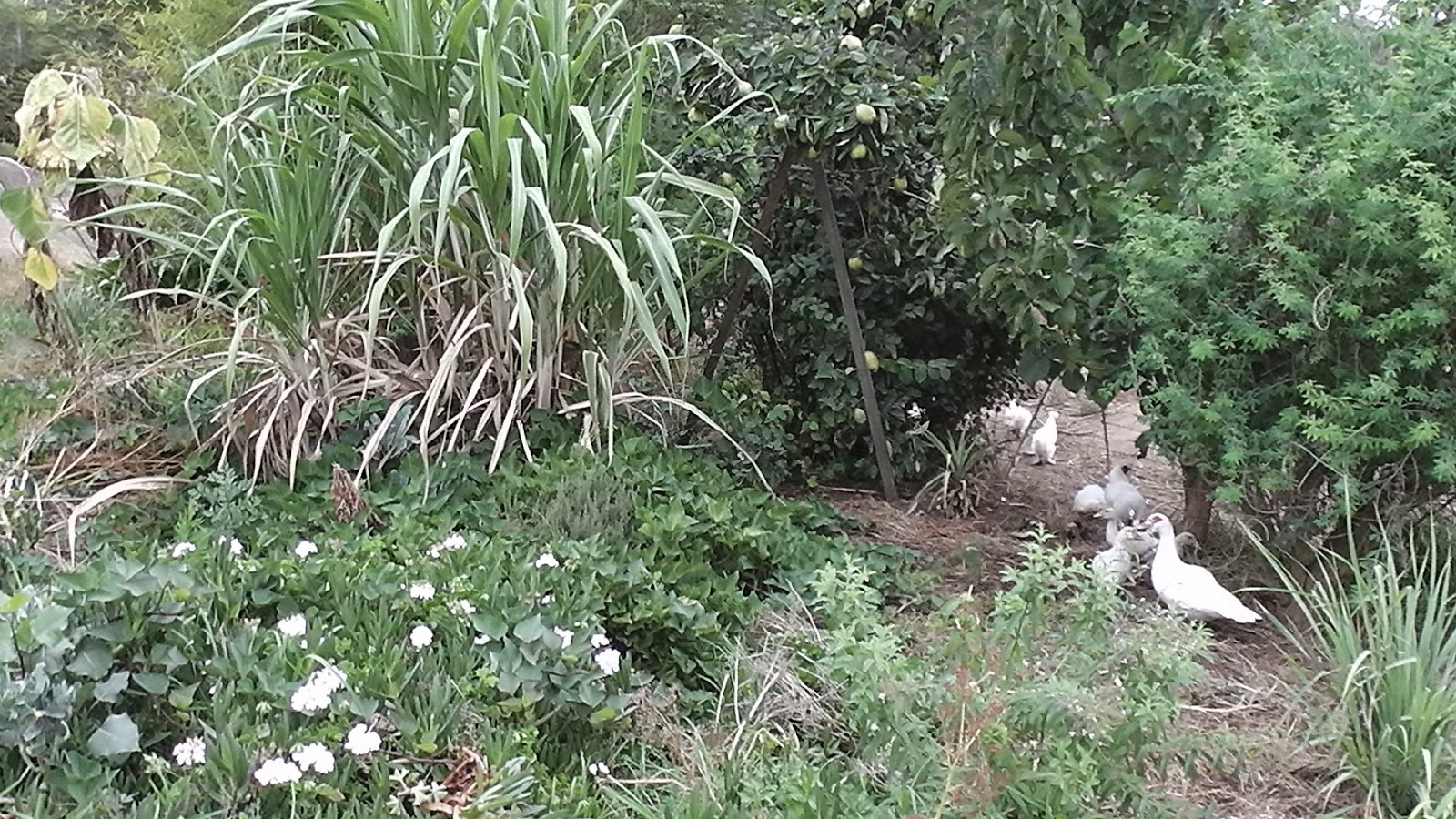
Here's some updated pics below. Its come to pass that the quince tree is bestowing its bounty to us and the pigs, as is the English Mulberry ( ducks and chooks love them), the sugar cane, sweet potatoes, sunflower, lemon verbena and mint ( makes a nice cup of tea), the golden bamboo shoots and the curry tree . Best of all, the avo has a dozen fruit on it.
Th Happy mulching !
Th Happy mulching !
 |
| same old ute in the driveway, but a far more productive area 3 years later. Its a formular that works. Go to it and post me some pics! |
Tuesday, December 20, 2011
 Sweet corn for the New to Gardening .
Check out our first crop of corn for the year, grown from last years saved seeds. Many people have commented on the excellent viability of our sweetcorn seeds, with 100% strike rate reported. Once again, rats are our problem in this crop. Bring on the owls!
Corn is a warm season frost tender plant so in Nannup it can be planted from September through to the end of February with relative safety. It is a heavy feeder so will grow best in soil enriched with compost and or worm castings and a protective layer of mulch. It will need irrigation in most Perth gardens , but a humus ( carbon ) rich soil will of course absorb and hold 6 times more water than a poor soil , so improve your soil and save on irrigation. Corn does not suffer many diseases or pests, except rats, so start controlling any rodent populations when you plant the seed. Very strong winds can blow them over , so a hedge of Jerusalem artichoke /sunflower is a good idea around a corn patch.
Best to plant corn in blocks of at least 12 plants, rather than rows, as pollination is by wind.
An un- pollinated corn cob has no nib lets! So you are likely to get corn on only one side of the cob if it is grown in a row.
Corn takes about 4 months from seed to sweet corn ready to pick. The Balinese variety usually has 2 cobs per plant . Knowing when to harvest can be tricky. Over or under ripe corn is a bit of a waste. You get to know by experience when it is ready. I sneak a look at the cobs just as the tassel has gone all dry and dark brown and the cob is looking fat, by peeling aside a few inches of green sheath leaves and seeing if the nib lets look plump and yellow. If not ready yet pat the leaves back in place to protect against the prying eyes of thieves like rats and parrots. Under ripe are cream coloured and small .Past their prime they look deeper yellow and a little shrunken.
Open pollinated corn is not a super sweet and tender as the hybrids, but it is still very nice , and I find it tastes actually better and more nutritious ( and probably is). The pale green corn silk surrounding the cob is edible and meant to be good urinary tract tonic and alkalising . The big advantage of open pollinated corn is, if you wish to save your own seed you can and it will be like the parent plants. Replanting saved hybrid seed is not recommended as it may not be anything like what you saved. To save seed choose the healthiest plants with the earliest, biggest, most numerous cobs and do not pick them to eat ( ohhh!!) but let them remain on the plant till all the plant and cob are withered and going brown. If you end up with lots of corn seed, tell the world because we need to maintain our open pollinated, non GE , non- patented seed stocks. And that’s best done by keeping good varieties alive and in the hands of many gardeners.

But surprise! All was not lost. On closer inspection we found the cobs lying on the ground untouched. …muddy, but otherwise unscathed. We peeled them and got the inch of water boiling in a big pot and threw them in . A feast of fresh corn ensued and froze the rest!
Subscribe to:
Posts (Atom)