Saturday, September 6, 2014

Winona La Duke

I have discovered Winona LaDuke.
See one of her many speeches hereWinona LaDuke to Speak
At UW-Eau Claire Forum 
   March 22, 2004— Winona LaDuke, an activist for social and environmental issues who served as the Green Party vice presidential candidate in the 1996 and 2000 elections, will close the 62nd season of The Forum at the University of Wisconsin-Eau Claire on Wednesday, April 7.
Her presentation titled “Environmental Justice from a Native Perspective” will begin at 7:30 p.m. in Zorn Arena. LaDuke’s lecture will be followed by a question-and-answer session and a reception.
An Ojibwe who lives on the White Earth reservation in Minnesota, LaDuke is program director of Honor the Earth, a national Native American environmental justice program. She is founding director of the White Earth Land Recovery Project, a reservation-based land acquisition, environmental advocacy and cultural organization, a former board member of Greenpeace USA and co-chair of the Indigenous Women’s Network.
Born in Los Angeles, LaDuke is a graduate of Harvard and Antioch Universities. In 1995 Time magazine named her as one of America’s 50 most promising leaders under 40 years of age. She was awarded the Thomas Merton Award in 1996, the Ann Bancroft Award for Women’s Leadership Fellowship and the Reebok Human Rights Award, with which she began the White Earth Land Recovery Project.
“The U.S. is the wealthiest and most dominant country in the world, and we can’t keep the lights on in New York City nor can we provide continuous power in a ‘liberated’ Baghdad,’ LaDuke wrote in a recent column for Indian Country Today. “Centralized power production based on fossil fuel and nuclear resources has served to centralize political power, to disconnect communities from responsibility and control over energy, and to create a vast wasteful system. We need to recover democracy. And one key element is democratizing power production.
“We are undeniably addicted whether to an economy based on burning of fossil fuels and wasteful production systems, or to oil,” LaDuke wrote. “We have allowed our addictions to overtake our common sense and a good portion of our decency. We live in a country with the largest disparity of wealth between rich and poor of any industrialized country in the world.”
LaDuke is the author of “All Our Relations: Native Struggles for Land and Life” (1999), a non-fiction work on Native environmentalism. “The Winona LaDuke Reader: A Collection of Essential Writings” was published in 2002.

Saturday, August 30, 2014

A taste of Permaculture tour Sunday June 5th 2016

Guided permaculture tour  Sun June 5th 2016

from 10 am  to 1.30 pm.  

Join Stew and Bee on Merri Bee Organic Farm,Sunday morning this long weekend for an introduction to Permaculture .  We will  take a wander through food forests, some 25 years old, visiting many friendly farm animals along the way. 
On this extensive guided tour you will see more than 90 different mature species of plants that provide fodder, fruit, timber, nuts craft materials or bee forage. Admire the happily grazing free range pigs, sheep, cows and ducks and marvel at the developing bamboo collection. See how nutrients are recycled and water flows through   this thriving eco system. 
Being spring on the farm we may see a chick hatching or a calf  being born if we are very lucky!
Stewart and Bee have  provided most of their own meat, vegetables, fruit, nuts, herbs, condiments, bread and dairy produce from this land for 30 years and are keen to
share  the really useful permaculture design principals which  start with an ethic ....care of Earth and care of people. We have created a day especially for those who  have decided to withdraw their support from multinational agribusiness / pharmaceutical corporations by simply refusing to buy their "food".
If  GMOs, pesticides, food additives, nanno particles, hormones, irradiation, and antibiotics, all packaged up in gaily coloured plastic and delivered via fossil fuel are not for you;   if you believe there must be a way  we can eat ,without adding huge toxic loads to our air, water and soil, then  please join us. Meet  others on the same path and pick up many helpful ideas. 


 Taste the forgotten flavours of compost grown fruit, nutrient dense veges and animal products. Children do appreciate real food and we would love your family to join us for a day of memorable experiences which show where food comes from.
The cost is $75 .00 per adult and $15.00 per child, which includes lunch and teas   . 

See the passive solar human and animal housing, intensive gardens, nursery, poultry sheds and runs, compost and compost tea  production, worm farm, wicking bed, swales, mature rare fruit and nut trees, raspberries, wood lots and  lots more. Bring appropriate footwear and clothing for steep hiking in the fresh air of Nannup.  This workshop will assist those looking for  a property as we  will focus on assessing a block's  potential for permaculture and the principals of design whilst simultaneously engaging your children.  Please note, you are responsible for your children's safety at all times on the farm but we will take all care as well. Please email beewinfield@westnet.com.au  after  booking  your spot (instructions  here) . We look forward to meeting you . Cheers, Bee


Sour Dough Bread Day Sunday June 21st 2015

Sour Dough Bread Day  Sunday June 21st 2015


Suffer bright white squares of pliable fluff no more!

Sour Dough Bread Day
  at  Merri Bee Organic Farm  on Sunday June 21st  2015
Please join us,  this will  be fun and useful.
 Merri Bee Organic Farm is a 27 acre Permaculture which has been developing for over 30 years . The visitor will find a broad array of tools and techniques for sustainable living, from soil restoration with worms, compost,  perennial pastures combined with managed grazing, food forestry and bamboo, to intensive gardens and hand made homes, we are growing  a place of genuine wealth and abundance . 
One very handy food which can be the most sustaining is bread. Whole wheat is definitely a super food. It is made more digestable by the sour dough fermentation process, and can introduce pro biotics to your intestinal flora. 
Our sourdough bread class, commences at 9 am and finishes  at 3.30 pm. 

We will teach you very clearly how to bake a bread that will outshine nearly all others not only in  health outcomes but in sheer eating pleasure.  Compared to yeast bread , sour dough bread is not crumbly, is moist and keeps very well without going mouldy. It should not taste sour.  We have taught many people the art and they have happily emailed pictures of their creations since doing the course, saying the family are stoked with their new baking skills.  We  provide 
everything: lunch and teas,  course notes, recipes, wonderful bread and starter culture to take home….. so just bring your enthusiasm to learn.
Let’s face facts; what passes for bread these days contains only 6 cents worth of wheat and a cocktail of emulsifiers, bleach, preservatives, and GM soy. It is no longer “the staff of life.” It is not fit for human or animal consumption , and in fact  animals will avoid it.
Over night two very different breads, each in a plastic bag, were in a box in our rough camp kitchen. The home made sourdough wheat bread  on the right was devoured by wild life  ( note the excavation) but wisely, they did not touch the commerical bread on left.

Wheat and Lee growing strongly in 2013
 Learn about how real sourdough bread (with it’s life enhancing nutritional properties) starts with a healthy soil. Follow the creation of bread from the paddock to the farmhouse where we will experience the intriguing age old practices of threshing, winnowing and  milling the grain. On this day you will become proficient at mixing, kneading and baking a bread that will provide essential nourishment for your family. We will show you the streamlined method which Bee uses to turn out 25 loaves every saturday for the markets. Of course you will not go hungry , we intend to send you home nourished with home made soup and many variations on  bread. Sample Merri Bee olives, dried fruits, fresh nuts and the fabulous fresh fruits bestowed on us in the food forest in June. All organic of course.
The cost of this powerfully educational day is   $ 120.00 per person or $200 per couple. For those individuals who car pool, there is a $20 discount.
For enquiries and /or to reserve your spot please email beewinfield@westnet.com.au  or phone Bee on 97561408


For further reading on the health benefits of wholewheat bread see the web site of the Dr Weston A Price Foundation. Dr Price used a freshly ground wheat gruel to heal children suffering from terminal disease. Sometimes very sick children were brought to  Dr Price when all hope was gone, even as  the priest had been called in to administer last rights to these children. His cure was freshly ground wheat, golden butter from cows in spring grass, and  whole milk. The young patients were running around in no time. Its all in his excellent  1920's published book  Nutrition and Physical Degeneration

Monday, August 18, 2014

Deflecting cancer

Once rare , now common, cancer touches all of us. 

Some humans have released carcinogenic substances into the air, soil, food and water. Radiation must also be building up as elements such as plutonium do not go away for several centuries. So how can we  reduce our exposure and risk ? The best help I've heard all in one place is from Jerry Brunetti,listen here: Food as Medicine  

Jerry unfortunately passed away a month ago. He  ( gorgeous BTW) was  a prolific writer and speaker on farming and health and a self treated survivor of non Hodgkin Lymphoma which he kept at bay 15 years after doctors gave him 6 months to live.  

He said  that tumours are not deadly, it is  metatastic illness which kills .  We all have cancer cells in our blood every day. It is our immune system that intercepts and deals with these "seeds" which emanate from tumours. Chemo weakens our immune system. There are heaps of foods that strengthen our immune systems and they are listed below.The list comes  from the Weston A Price Foundation . 

I notice that everything but the seafood is available from us. We are very proud to be able to supply the variety and quality of food required to be healing and protective, from our permaculture. We have stopped frying in anything but animal fats and consume them gently heated if not raw. Only the cold pressed oils will do, such as olive , and these
Our avos grown with quality compost. The African Horned Cue is high in Vit C
 should not be heated. Not all people see the wisdom in paying more for their groceries but how much would you  spend to cure a sick loved one? Diet related  diseases are  costing Australia, Canada and the U.S. a whopping  80%  of GDP.and of course cancer is a booming industry.
 In  2008, America spent $76.6 billion on caring for children ill due to exposure to farm chemicals.

Its time to find out how to :

Protect Yourself Against Cancer With Food

Once a rare disease, cancer is now widespread, affecting as much as one-third of the population. The rise in cancer in the West has paralleled the rise in factory farming and the use of processed foods containing vegetable oils and additives.
Orthodox methods for treating cancer (radiation and chemotherapy) do not prolong life. The best approach to cancer is prevention.
Traditional diets, containing animal and plant foods farmed by nontoxic methods, are rich in factors that protect against cancer. Many of these protective factors are in the animal fats.
Vegetarianism does not protect against cancer. In fact, vegetarians are particularly prone to cancers of the nervous system and reproductive organs.

Nutrients in Whole Foods that Protect Against Cancer

Vitamin A: Strengthens the immune system. Essential for mineral metabolism and endocrine function. Helps detoxify. True vitamin A is found only in animal foods such as cod liver oil; fish and shellfish; and liver, butter and egg yolks from pasture-fed animals. Traditional diets contained ten times more vitamin A than the typical modern American diet.
Vitamin C: An important antioxidant that prevents damage by free radicals. Found in many fruits and vegetables but also in certain organ meats valued by primitive peoples.
Vitamin B6: Deficiencies are associated with cancer. Contributes to the function of over 100 enzymes. Most available from animal foods.
Vitamin B12: Deficiencies are associated with cancer. Found only in animal foods.
Vitamin B17: Protects against cancer. Found in a variety of organically grown grains, legumes, nuts and berries.
Vitamin D: Required for mineral absorption. Strongly protective against breast and colon cancer. Found only in animal foods such as cod liver oil, lard, shellfish and butterfat, organ meats and egg yolks from grass-fed animals. Traditional diets contained ten times more vitamin D than the typical modern American diet.
Vitamin E: Works as an antioxidant at the cellular level. Found in unprocessed oils as well as in animal fats like butter and egg yolks.
Conjugated Linoleic Acid (CLA): Strongly protective against breast cancer. Found in the butterfat and meat fat of grass-fed ruminant animals.
Cholesterol: A potent antioxidant that protects against free radicals in cell membranes. Found only in animal foods.
Minerals: The body needs generous amounts of a wide variety of minerals to protect itself against cancer. Minerals like zinc, magnesium and selenium are vital components of enzymes that help the body fight carcinogens. Minerals are more easily absorbed from animal foods.
Lactic Acid and Friendly Bacteria: Contribute to the health of the digestive tract. Found in old fashioned lacto-fermented foods.
Saturated Fats: Strengthen the immune system. Needed for proper use of the essential fatty acids. The lungs cannot function without saturated fats. Found mostly in animal foods.
Long-Chain Fatty Acids: Arachidonic acid (AA), eicosapentaenoic acid (EPA) and docosahexaenoic acid (DHA) help fight cancer on the cellular level. They are found mostly in animal foods such as butter, organ meats, cod liver oil and seafood.
Co-enzyme Q10: Highly protective against cancer. Found only in animal foods.

Compounds in Processed Foods that Can Cause Cancer

Trans Fatty Acids: Imitation fats in shortenings, margarines and most commercial baked goods and snack foods. Strongly associated with cancer of the lungs and reproductive organs.
Rancid fats: Industrial processing creates rancidity (free radicals) in commercial vegetable oils.
Omega-6 fatty acids: Although needed in small amounts, an excess can contribute to cancer. Dangerously high levels of omega-6 fatty acids are due to the overuse of vegetable oils in modern diets.
MSG: Associated with brain cancer. Found in almost all processed foods, even when "MSG" does not appear on the label. Flavorings, spice mixes and hydrolyzed protein contain MSG.
Aspartame: Imitation sweetener in diet foods and beverages. Associated with brain cancer.
Pesticides: Associated with many types of cancer. Found in most commercial vegetable oils, fruit juices, vegetables and fruits.
Hormones: Found in animals raised in confinement on soy and grains. Plant-based hormones are plentiful in soy foods.
Artificial Flavorings and Colors: Associated with various types of cancers, especially when consumed in large amounts in a diet of junk food.
Refined Carbohydrates: Sugar, high fructose corn syrup and white flour are devoid of nutrients. The body uses up nutrients from other foods to process refined carbohydrates. Tumor growth is associated with sugar consumption.

The Weston A. Price Foundation

·         A reliable source of accurate nutrition information.
·         A strong voice against imitation foods.
·         Does not receive funding from any government agency, nor from the meat and dairy industries.
·         Campaigns for a return to healthy traditional fats.
·         Warns consumers about the dangers of modern soy foods.
·         Promotes access to unprocessed whole milk products from pasture-fed animals.
·         Keeps members informed through Wise Traditions, a lively quarterly magazine.

·         Helps consumers find healthy, farm-fresh foods through a system of local chapters.

Monday, July 28, 2014

Ducky dream homes

Ducks are cheaper to keep than chooks because they just seem to get by without much grain. This is great for Permies, as we are usually penniless, building up real wealth (starting with the soil). With ducks you can plant stuff to attract slugs and snails, so the sappy , strappy and succulent plants (like agapanthus that usually get infested with molluscs) are great. Ducks love to snaffle around in them with their very busy bills, cleaning up slugs snails and their tiny, clear, caviar- like eggs. Get your organic minded old friends to collect snails from their gardens  for your ducks, and maybe you can return the favour with duck eggs. There is nothing nicer than a duck egg, such large and rich yellow yolks. To me they don't taste different but are just bigger. 

 In old China it was common to rent- a -duck flock to clean up your garden in the winter. A guy would come with his ducks in a trailer pulled by bicycle. The ramp went down , the ducks emerged and went rifling through the plot . At the end of the day the ducks were enticed back into the trailer , or should I say the last duck up the ramp got a tap with a bamboo cane. The Chinese use to hatch out eggs in cane baskets heated and  insulated in some way. They would bond with their birds from hatching day and for the next 6 week. With cormorants the fisherman lived on a boat and when it was hatching time they would go below decks in the darkness with the baby birds for these 6 weeks  . They then had a faithful servant who for decades would catch fish for their master. But back to us:
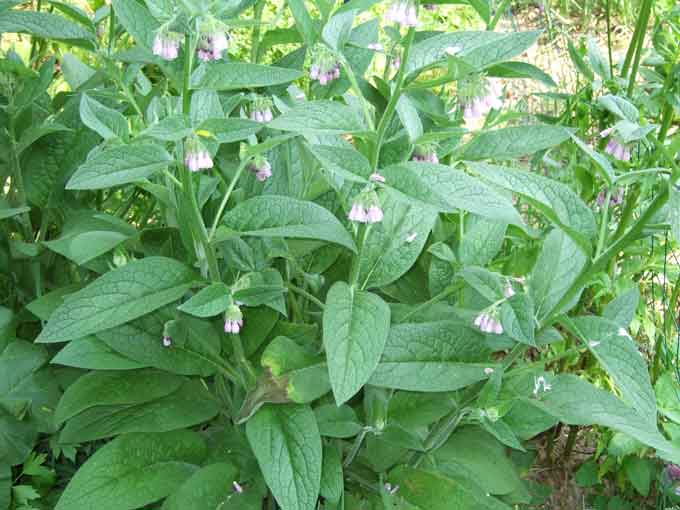
  Comfrey is a great favorite with ducks but must be established a few years before they are introduced as they will love it to death. I have had to put cages over my comfrey to save it from ducks.
Oh crikey , they love chicory to stumps  too. So they have great taste and favour the deep rooted herbs which have lots of minerals. I haven’t got them on the seed catalogue but I do have some alfalfa and chicory seeds if you like to order some within Australia please email me ( beewinfield@westnet.com.au). There'll be a lot more very good plants which I haven’t observed yet but now that you’ve asked I will keep my eyes out. It would be good to have at least 2 pens and a house in the middle with hatches to either pen, to allow the plants to regrow between onslaughts.
 Put some hay in the house and if the house is locked up against foxes at night there will be nice clean eggs in the morning when you let them out for the day. We have a duck pond in their pen which is a bad idea: the sillie billies lay eggs in the water. On the good side, the ducks swim out over the pond to freedom of the fields very early, leaving their more destructive friends the chooks inside the pen ( as they cant swim)  till midday. Chooks really are like small rotary hoes whose energies are best controlled . 
 It really isnt groovy to allow ducks near the chooks water supply as they will muddy it up in seconds.  But you can easily block duck access to the water with a small fence that the chooks will easily jump over.  The permaculture principle of " turning a problem into a solution" means we can use the habit of ducks to foul their water to great effect if we place a movable duck pond such as the half shell plastic paddle pools available in the colder months for just $12.oo, in the orchard. The ducks will naturally congregate under the shady fruit tree at the pond. A hose can be connected to whatever irrigation system you are using for the trees. The dirty water is tipped out, the pond moved to the next tree and refilled as often as you can be bothered. The ducks will eat low fruit, but there should be plenty enough for you. The kahki Cambell and Indian Runner ( egg laying type ) ducks do not fly . The dual purpose meat and egg laying duck the Muscovey however, will fly even though they are a far heavier bird. They not only fly, they employ vertical takeoff like a helicopter, making them ever so hard to catch.  We only put up with them because of they are so funny to watch and have heaps of personality. Remember the duck in Babe? A muscovey.  I find them better layers and better mothers than our aging pekins too, but it all depends on the strain of duck you have. I once had some awesome Kahki Cambells. 

Sunday, July 13, 2014

Chook Heaven

My friend wrote to me asking for help with her chooks. They hadn't laid an egg since December in spite of the best of care and conditions. I thought some of you dear readers would be interested in my reply. It has turned into quite a chapter on chooks, so here goes!
Hi Sall, 
Six months without eggs, that's tragic, whatever could be their excuse? First, to cover all bases I will outline the needs of a chicken. I said chicken for American readers. Better define the
 life stages of a hen first: In Australia, a chicken is very young, . It is fluffy and  hasn't fully feathered up.
Under organic standards for meat birds, your stock should come from day old chicks, week old for layers.This is because antibiotics are fed from day one in commercial operation.  After 6 weeks the chicks have grown their hard feathers and can leave their mother's  nest ( or the artificial equivalent ....the heat lamp).
hen on nest in clucky hen coop made by Bee
We call a newly feathered fowl a teenager here at Merri Bee Organic Farm, but officially it is a "started pullet", then a " grower", then at 6 months , a point of lay pullet, then a "layer"  or  chook . An "old boiler" is one who has past her prime as a layer. Now in commercial egg production, that is at just  18 months. We don't retire our fowls to chorizo or soup till about 4 years and many are  far older, but shame on us. You should really replace your chooks every 2 years for best production. 


Back to describing
 chook heaven.  What is it like, living the dream, if you are a chook?

 Bear in mind, modern fowls descend from jungle fowls in Asia.
mother hen and pullets

Being able to jump down from your secure perch early in the morning to catch and devour the protein rich fauna still moving about in the wet herbage is important. As we all know, the early bird gets the worm.
 As the sun climbs higher, the shade of trees and under-story plants, again rich habitat for insects, is a must. Living on the edge of a food forest would be ideal. As Bill Mollison says, create edges wherever you can. To peck ones fill from fresh green plants is vital, and as always a diversity of plants is best. In winter,  pampered poultry  have access to silver beet /chards , kale, cabbage, chicory,  lettuce, endive, parsley and pasture. Pasture consist of no less than 80 species for prize race horses, as highlighted by Peter Andrews in his book "Back from the Brink". Heavenly fields would contain the perennial grasses  with huge root systems: cocksfoot, phalaris, fescues tall wheat grass, kangaroo grass. Very  nutritious herbs with deep tap roots to bring up minerals from the deep include dandelions, marsh mallow and the all important comfrey, chicory and alfalfa. Scarlet runner  and choko are 2 perennial climbers which also die back in winter but come back for 7 years.
comfrey
Alfalfa or lucerne. Its roots go down 6 feet. 
These plants may die down in winter in cold climates but will power away in spring and  like the perrenial grasses , will stay green with minimal summer rain or irrigation.  The legumes will feed your fowls and your grasses , so look to clovers, trefoils , vetches, and again alfalfa or lucerne. Annual legumes like Broad beans, peas and lupins , nitrogen fixation nodules as well as  store-able protein.  In our hell dry summers, a mix of kale, amaranthus, marsh mallow, millet, sorghum , and sunflower seem to survive in the dust somehow.
 Sorrell and purslane are useful summer "weeds", the purslane being one of the richest sources of omega 3 oils besides flax or linseed which should always be sown in autumn for the fowls and menopausal women. With the first rains, broad cast the  annual cereals ( wheat, rye, barley etc), and mix in peas and lupins for protein and nitrogen fixation. In spring sow annual beans such as borlotti, snake bean , kidney , navy and the climber/ soil improver lab lab. They will do well in summer if they get their roots down in spring before the big dry. Lastly, pumpkin is important for its zinc rich  seed, so when you bung on some roast veges for tea, remember to put the seeds in the kitchen " chook bucket." I also put any compostable waste in there. They love trawling through for treasures such as macadamia nut meats clinging to shells, slaters etc and in the process shredding our paper waste.
Biological Paper shredder at work. If no rain , a light sprinkle with a hose will generate furious shredding  activity. Note the little gates in the corrugated iron which lead out to vege garden beds surrounded by cheap bird net. Its cheap but we are always sewing up the holes made by (we suspect) rats.


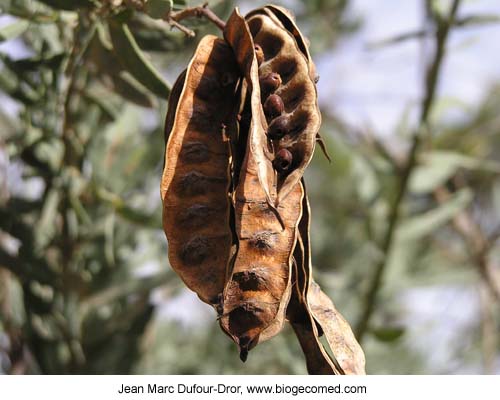
Of the tree crops useful to poultry Acacia has got to be essential as it's seed has  protein contents of 18%, is abundant on the ground under trees in high summer , easily collected and stored if you really want to, and the trees are fast growing shade and shelter .   Ever-lovin  Tagasaste , siberian pea tree mulberry and sea berry rank equal to the acacias. I can grow pigeon peas for a few years but frost usually takes them out well before they die of old age at 6 years. You will find many of the plants mentioned above in our seed catalogue http://merribeeorganicfarm.blogspot.com.au/2012/10/merri-bee-organic-seeds_3190.html

Acacia Victoriae  has particularly big seeds. 


 According to Juliette Levy in her Herbal Handbook for Farm and Stable, a mixture of dried stinging nettle, kelp and comfrey is a stimulant for egg production . I reckon even the feather dusters may start laying eggs on this mixture. 
In addition to the natural diet described above, the chook needs a dry area for dust bathing ( you can add ashes, dried leaves of insecticidal plants such as eucalyptus, southernwood and wormwood  to their dust bath for added protection against body lice /mites/. ) and ad- lib access to shell grit ( or powdered lime stone). Yes you can dry their eggshells out and crush them and add to the shell grit. We don't feed fresh egg shells because it may encourage egg eating, and \ if you have dirty eggs or none at all, suspect an out break of this. Any chook you catch in the act  should be despatched immediately, no buts. This vice is easily taught to other chooks and before you know it it will become far cheaper to buy your eggs from someone else! 
Water of course  is the most basic need  and going thirsty will definitely stop egg production if not kill your fowls. Bear in mind that chooks will not enter bright sun to access water  so in summer, water must be in the shade and access to it must remain in the shade throughout the heat of the day . Automatic watering devices are a must really, and cleaning off  the dark green algae that always grows in the water container now and then is only fair to them .
 You won't get any eggs if a fox eats your chooks so again, a statement of the bleedin' obvious: Lock your chooks up at dusk in a dog and fox proof enclosure. Don't listen if someone tries to tell you foxes wont swim across a moat to get your chooks, they do . See my earlier post on this blog http://merribeeorganicfarm.blogspot.com.au/2014/01/raising-chickens.html

Other predators in our area include the wedge tail eagle and the chudditch . It is commonly known by two other names, the western quoll and the western native cat. This species has become endangered due to loss of habitat and increased predator activity. Fires account for much of the habitat loss. The chudditch can be found in the Jarrah Forest located in south Western Australia, the population of the species in that location is estimated at 3,000 animals. This species is regarded as the largest marsupial predator located in Western Australia.
Goannas
will eat eggs and this can be a real problem in January around here. We have transported one daily visitor by car to far off forests but either he /she or another one in its place comes back every day to eat eggs and sometimes to chew the leg off a chicken!  Pogo is a cute little silky bantam that lost a leg in this very manner in her youth.

Look Sal, this one has me stumped. Old chooks should give you one egg a week unless they  are fully geriatric or in their annual moulting period. The moult  is obvious, they go around looking shocking with only half their feathers for up to 8 weeks. This usually occurs in mid winter, but flocks take turns moulting we have found. Each flock should have a rooster for protection and ideally should be no larger than 25 fowls. Then the pecking order is established and no daily squabbles for supremacy occur as happens in larger flocks where there are too many chooks to recognise and know! So, firstly, are they laying at all?  I want you to check the distance between pelvic bones of a few of your lazy  chooks . If you can insert 2 fingers between these bones , the chook will lay soon or is going off the lay. If you can insert 3 fingers , she is a good layer in fine form.  If only 1 finger will fit, she is soup mate.  Other signs of a non layer are:
* you see her going to bed early and getting up late 
* she has a small pale coloured comb
* is fat and lethargic. 
If  your chooks look like non layers, try adding kelp to the feed and  increasing protein in the ration. I believe the chook food you are buying is organic so we are safe from GM rubbish there,  but a protein hit like milk, meat , insects legumes may be needed . I understand your girls are very lucky and have free range . I do hope the land has never had organophosphates or organochlorines applied which hang around forever and would minimize insect numbers and of course contaminate your eggs with pesticide residues. These OC's and OP's lodge in our body fat and in the fat of egg yolks and accumulate as they do not leave the body easily, but I am sure you know that. Everyone running chooks, cows or pigs and eating their products should ensure their land is clean of pesticides by a soil test on day one. Sheep, not so bad but the above mentioned critters eating habits mean they ingest dirt. 
Just as awful to contemplate as a persistant pesticide residue is the only other thing I can think of: human poachers??? Long shot I should think. 
Anyway, get back to me with any more observations and I will keep thinking. 

If you are interested in attending a workshop on keeping back yard chooks for eggs and meat , where we will go into even more detail in a very hands on way,  please email me and register your interest.